I remember the first time that I was asked to present to the Senior Leadership Team. The experience in my body wasn’t unlike the time I went on a Go Ape course, thinking that my fear of heights wouldn’t be an issue (that was not the finest hour of my life). My stomach jumped to the back of my throat and my limbs went a bit fizzy with a strange mix of fear and excitement.
Then I started to be aware of the thoughts tapping me on the shoulder. “What if you make a fool of yourself?”, “What if they ask you a question that you don’t know the answer to?”, “What if you go bright red and start to stutter?”. A creeping feeling of dread started to come over me and I began to feel as if I had made a very big mistake in saying yes.
Instead of sitting down and preparing for the presentation I kept getting drawn into answering my, suddenly very urgent, emails. In the evenings, I noticed that I felt drawn to watching reality TV, eating comforting snacks and scrolling on my phone.
I ended up preparing my presentation at the last minute, feeling an incredible amount of pressure, with my mind thinking of ways to get out of it even up until the minute before I went through the door.
The presentation was fine, it could have been better, but it was ok. My internal experience was not fine, I’d spent two weeks on edge, using avoidance tactics to handle the discomfort and then had a frantic couple of days at the end.
It was only when I discovered Acceptance and Commitment Therapy (ACT) and started training and coaching others how to use its techniques that I realised that it doesn’t have to be this way.
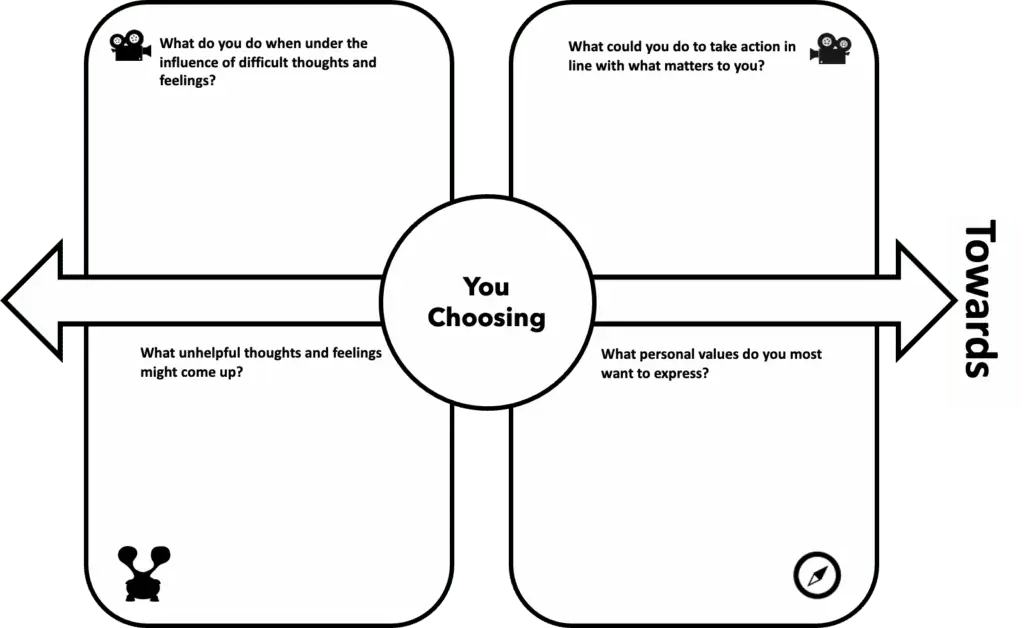
There is a tool in Acceptance and Commitment Therapy called The Matrix. The Matrix is a helpful tool if you have a challenge coming up and you know that unhelpful thoughts and feelings can result in it feeling like you are sabotaging yourself. The Matrix guides you to step back and ask yourself four questions:
- What unhelpful thoughts and feelings might come up?
For me this was a feeling of anxiety and thoughts like “I’m going to make a fool of myself”. Noticing and naming these without judgement is a helpful first step. With ACT we aren’t looking to change these thoughts and feelings, they are a natural human response, instead we are aiming to change what behaviour happens next.
- What do you do when under the influence of difficult thoughts and feelings?
The issue comes when we become ‘hooked’ with the unhelpful thoughts and feelings. This can result in us getting caught in rumination, where the thoughts just go round and round on a loop, or we can (like I did) try to avoid or distract ourselves from the discomfort. I always know something is up when I’m watching a classic like Love Island and eating giant chocolate buttons. Again, there is power in just noticing and naming these behaviours, without judgement.
- What personal values do you most want to express?
Values are the qualities of being that are most important to you. In the example of giving a presentation, the values that it would have been helpful to connect to are my values of creativity (designing the presentation to be engaging), service (wanting the presentation to make a positive difference) and learning (hoping that the audience will learn something and seeing the experience itself as an opportunity to learn).
- What could you do to take action in line with what matters to you?
When I connect with my values it’s like I loosen the grip of my unhelpful thoughts and feelings and I’m able to step back a little from them and focus my attention on what is really important. When preparing for a presentation, if my values are the driving force, I do things like find out what the audience need to get from it, research the presentation medium that will have the biggest impact and I sit down and prioritise writing the session early so that I have time to check it through with colleagues and to practice it. In doing this I’m taking my attention away from managing my mind and directing it to the needs of my audience.
I have found that the power in these questions is that it strengthens our ability to notice when we’ve become ‘hooked’ by unhelpful thoughts and feelings. When we notice this, we’re better able to step back and ask ourselves “what can I do next that will be aligned with my values?”. Every time I practice this, I know that I am strengthening my ability to compassionately catch myself and to redirect my attention to something that is more helpful.
Here is the Matrix in a visual form. Why not have a go at filling in the boxes for a challenge you have coming up and see what it might unlock for you.
Polk, Schoendorff, Webster & Olaz (2016),
If you’re interested in finding out more about Acceptance and Commitment Therapy and how it’s tools could help you in a coaching context then please message me. It’s a powerful, evidence-based approach that has supported me, and many of my clients, to relate differently to challenges and to our minds.